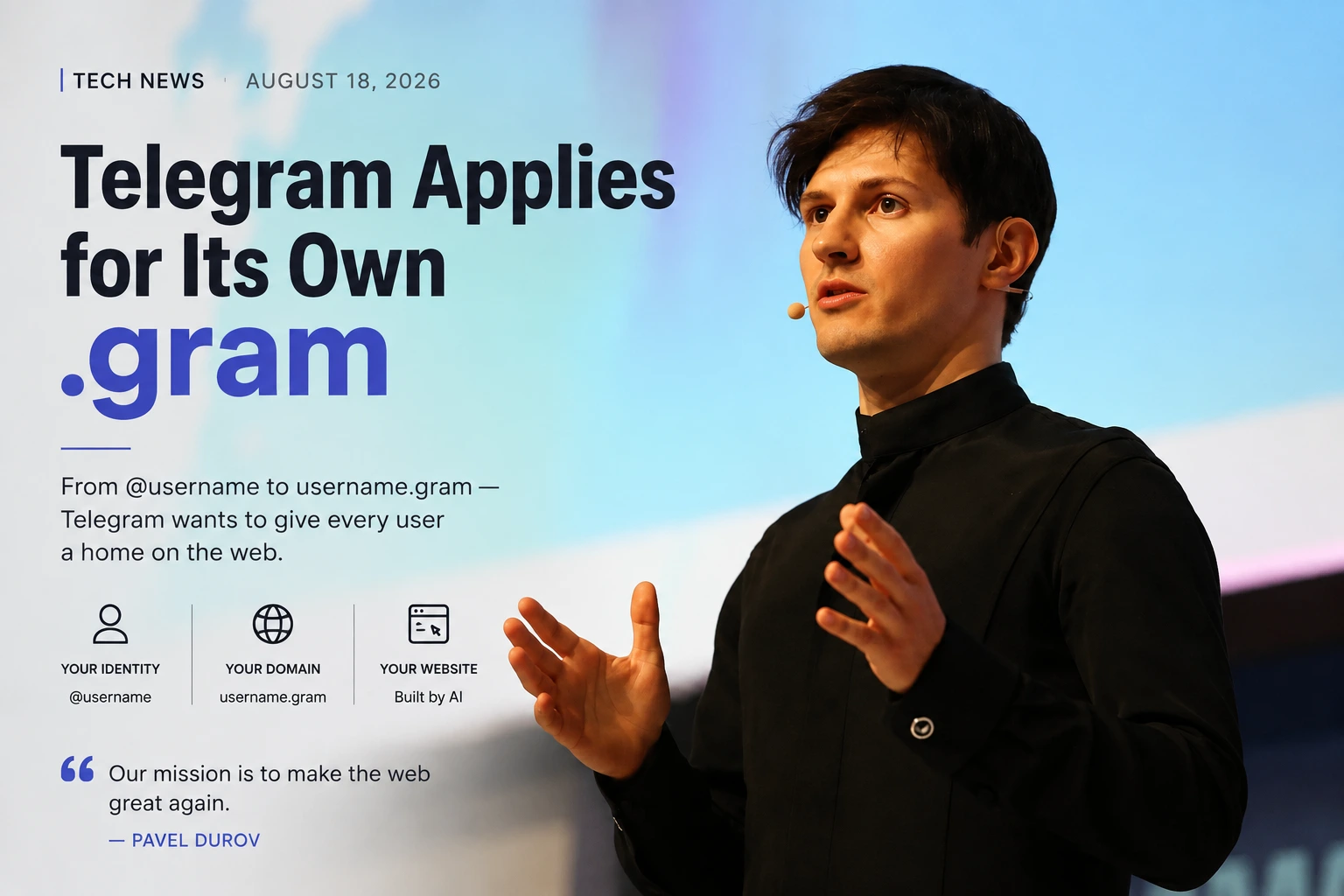
Telegram founder Pavel Durov has announced that Telegram has applied to create its own top-level domain: .gram.
The idea is simple enough to understand, but much bigger than it first appears.
If the application is approved by the Internet Corporation for Assigned Names and Numbers (ICANN), Telegram says its users could get domains based on their Telegram usernames.
So instead of thinking of an identity as:
@durov
you could potentially have:
durov.gram
And Durov says Telegram could go further: users could create interactive websites hosted on Telegram simply by describing what they want in a prompt.
That is the announcement.
But the interesting part is what it could mean for the web.
First, .gram is not a normal website domain yet
There is an important distinction here.
Telegram has applied for .gram. That does not mean .gram has already been approved or is available for registration.
ICANN’s 2026 New gTLD application window ran from April 30 to August 12, 2026. Applications now go through several stages, including administrative checks, evaluation, community input, objections and appeals, and, where necessary, contention resolution. Successful applicants eventually have to contract with ICANN and complete technical onboarding before a new TLD can be delegated.
So for now:
.gram is a proposal, not a live domain extension.
That distinction matters because it is easy to read the announcement and assume that username.gram domains can already be purchased.
They cannot.
Why does Telegram want its own TLD?
At first glance, it might look like a branding exercise.
It probably isn’t only that.
Telegram currently relies heavily on the t.me domain for links to channels, groups and other Telegram destinations. In July 2026, t.me stopped working for roughly a day before the domain came back online. TechCrunch reported that the domain had been placed on hold by the .me registry, with the registry later citing OFAC compliance.
That incident highlighted something important:
Telegram does not completely control the domain infrastructure underneath t.me.
A top-level domain controlled by Telegram could give the company much more control over an important part of its address system.
That does not mean the July outage is officially the reason for the .gram application. Telegram has not publicly stated that the application was made because of that incident. But the timing makes the idea particularly interesting.
From username to identity
The bigger idea is turning a Telegram username into something that exists outside the messaging interface.
Durov’s example is straightforward:
@durov→durov.gram
The important shift is conceptual.
A username normally identifies you inside a platform.
A domain identifies something on the web.
If Telegram connects those two things, your Telegram identity could become the starting point for a much larger online presence.
Imagine a creator with:
@alice
Instead of maintaining a Telegram profile, a separate website, a newsletter platform and several other services, Telegram could eventually offer:
alice.gram
That domain could contain her profile, articles, projects, contact information, links and interactive tools.
The website would still be connected to Telegram’s ecosystem, but the identity would look much more like a traditional web presence.
Then there is the more ambitious part: websites by prompt
This is the part that deserves more attention.
Durov said Telegram users could eventually create interactive websites on their .gram domains simply by typing a prompt.
In other words, Telegram is not merely talking about giving users new addresses.
It is suggesting a workflow something like:
Username → domain → prompt → website
That is a very different model from the traditional web.
Today, creating a website usually means choosing a domain, finding hosting, selecting a framework or website builder, designing pages, configuring deployment and maintaining the result.
A prompt-based system could hide most of that complexity.
A user could potentially say:
“Build me a portfolio for my photography.”
and receive a working site at their .gram address.
That would put Telegram closer to the territory occupied by website builders and AI-powered development tools.
There is already plenty of movement in this direction across the technology industry, but Telegram has something many of those tools do not: a huge existing user identity system.
Why the username matters
Telegram says that, if approved, the .gram system could potentially give a billion users their own second-level domains. Durov specifically used durov.gram and monk.gram as examples.
That scale changes the economics of the idea.
Telegram would not need to convince people to sign up for a new identity.
The identity already exists.
That is powerful.
Consider the difference:
Traditional web
I want a website
        ↓
Find a name
        ↓
Buy a domain
        ↓
Buy/choose hosting
        ↓
Build the website
        ↓
Deploy it
        ↓
Maintain it
Possible .gram model
I already have @username
        ↓
username.gram
        ↓
Describe what I want
        ↓
Website
The second model dramatically lowers the barrier to having a personal presence on the web.
But there is a catch
The biggest misconception would be to interpret .gram as though Telegram has already created a new decentralized Internet.
It has not.
And a Telegram-operated TLD would not automatically make the web decentralized.
A TLD is part of the DNS system, and a registry operator controls important parts of how names under that TLD are allocated and managed.
So there is an interesting tension here.
Telegram has long positioned itself around ideas such as privacy, user autonomy and resistance to centralized control. At the same time, a company-operated domain namespace would place a significant amount of infrastructure under the control of one organization.
That does not make .gram inherently good or bad.
It simply means that “more control for Telegram” and “more freedom for users” can both be true at the same time.
The actual rules of the future .gram registry would matter enormously.
The web is becoming less visible underneath the interface
There is another way to look at this announcement.
For most people, the web is already disappearing behind applications.
People don’t think about URLs very much anymore.
They open Instagram instead of visiting a website.
They open YouTube instead of browsing a video site.
They open Telegram instead of navigating the web.
Now imagine if the application itself could also create your identity, domain and website.
That would make the traditional boundary between:
app → account → website
much thinner.
Telegram would not simply be a messaging application anymore.
It would be providing pieces of an identity layer, communication layer and publishing layer at the same time.
And the prompt-based website idea adds an AI-generated software layer on top of that.
That is why the .gram announcement is more interesting than the domain name itself.
What happens next?
For now, there is a lot of uncertainty.
Telegram has submitted its application, but approval is not guaranteed. ICANN’s process includes technical and policy evaluations, community input, objections and appeals, and other stages before a successful string can eventually be delegated.
So we should not start expecting username.gram websites to appear tomorrow.
The interesting question is not whether .gram sounds cool.
It is whether Telegram can turn its enormous existing network of usernames into a broader web identity system.
If it succeeds, the domain itself may be only the first part.
The bigger product could be:
identity + messaging + publishing + websites + AI
all connected to one username.
And that is a much more ambitious idea than simply creating another domain extension.
The takeaway
Telegram’s .gram application is easy to summarize as:
“Telegram wants its own domain.”
But that undersells it.
The more interesting idea is that Telegram may be trying to make a user’s Telegram identity become their identity on the web.
That could make creating a website dramatically easier.
It could also give Telegram more control over the infrastructure surrounding its users.
Whether that becomes a meaningful shift in how people use the web depends on what Telegram actually builds, whether .gram is approved, and how the system is governed.
For now, .gram is still an application.
But the idea behind it is worth watching.